YADOCT PRIVACY POLICY
This policy explains how Yadoct collects, uses, and protects your data.
Last Updated: 20 September 2026 Effective Date: 22 May 2026 Jurisdiction: People's Democratic Republic of Algeria Applicable Law: Algerian Law No. 18-07 on protection of personal data Data Controller: EURL Yadoct Contact: [email protected]
1. PURPOSE, SCOPE AND DEFINITIONS
This Privacy Policy describes how Yadoct processes personal data in accordance with Algerian Law No. 18-07 when you use our platform, including web, mobile, and clinic systems (the "Services").
Definitions
- Personal Data: Any information relating to an identified or identifiable natural person.
- Health Data: Sensitive personal data related to physical or mental health.
- User: Any patient or healthcare provider using the Services.
- Provider: Licensed healthcare professional or medical organization using Yadoct.
This Policy applies exclusively to users aged 18 years and above.
2. ROLES AND RESPONSIBILITIES
2.1 Yadoct
Yadoct acts as data controller for platform operations including:
- Account management
- Appointment systems
- Messaging infrastructure
- Telemedicine infrastructure
2.2 Healthcare Providers
Healthcare Providers act as independent data controllers for:
- Medical diagnosis
- Clinical decision-making
- Treatment and prescriptions
Yadoct does not provide medical services and does not interfere with clinical decisions.
3. CATEGORIES OF DATA COLLECTED
We apply data minimization principles and only collect data necessary for healthcare services.
3.1 Identity and Account Data
- Full name
- Date of birth (18+ verification)
- Phone number
- Email address
- Authentication credentials
3.2 Health Data (Sensitive Data)
- Medical history
- Symptoms and consultation notes
- Prescriptions
- Laboratory and imaging results
- Allergies and chronic conditions
- Vaccination records
Where a practice has enabled the optional mode described in Section 9.3, this data only reaches us encrypted, under a key we do not hold.
3.3 Technical Data
- Device type and operating system
- IP address
- Authentication logs
- Application usage logs
3.4 Communication Data
- Messages between patient and provider
- Appointment history
- Support communications
3.5 Device Permissions (Optional)
- Camera (document upload, profile image)
- Microphone (telemedicine calls)
- Location (provider search)
- Notifications (alerts)
4. PURPOSE AND LEGAL BASES
We process personal data only for specific, explicit, and legitimate purposes:
4.1 Purposes
- Provision of healthcare appointment services
- Telemedicine consultations
- Medical record management
- Communication between users and providers
- Platform security and fraud prevention
- Legal compliance under Algerian Law No. 18-07
- Service improvement using aggregated anonymized data
4.2 Legal Bases
- Contract performance (Service delivery)
- Legal obligations (health, tax, regulatory compliance)
- Explicit consent (optional features only)
- Legitimate interest (security, fraud prevention, system stability)
5. PROHIBITED USE OF DATA
We explicitly state:
- We do not sell personal or health data
- We do not use health data for advertising
- We do not perform automated medical diagnosis or treatment decisions
- We do not profile users for behavioral advertising
6. DATA SHARING AND DISCLOSURE
We share data only when strictly necessary.
6.1 Healthcare Providers
Data is shared with selected providers for medical consultation and treatment.
6.2 Service Providers (Processors)
We use third-party processors under strict contractual agreements:
- Payment processing (Chargily Pay)
- Server hosting and infrastructure (Algérie Télécom SPA, Algeria)
- Messaging and notification services (SMS/email)
- Telemedicine infrastructure
Processors are prohibited from using data for any independent purpose.
6.3 Legal Authorities
Data may be disclosed when required by Algerian law or valid legal request.
6.4 Business Transfers
In case of merger or acquisition, users will be informed prior to any data transfer.
6.5 Who Inside a Practice Can Open Your Record
Access to a record is confined to the practice treating you. On every request our servers check that the record asked for belongs to the account asking: a healthcare provider reaches only their own records, a staff member only those of the practice employing them, a clinic only those of the practitioners attached to it. No provider can open another practice's record.
Within a practice, staff access is not automatic. The practice owner grants permissions one by one; those that open the medical record are never ticked by default and are flagged as sensitive when they are granted. A permission that was not granted is refused by the server, not merely hidden in the interface. Access to medical data is logged (Section 11).
7. TELEMEDICINE
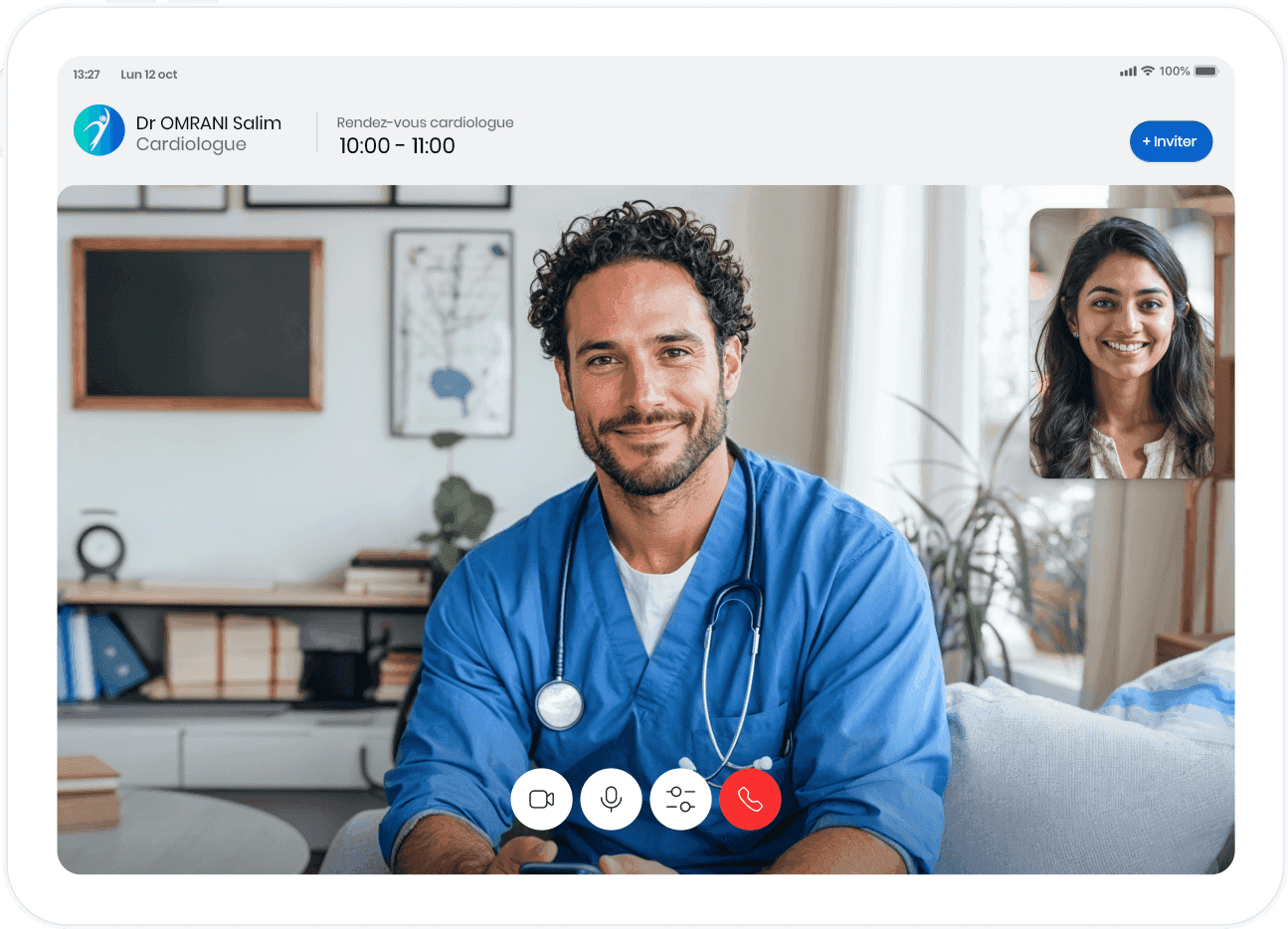
Teleconsultations take place over live audio/video. Yadoct does not record them. The platform has no call-recording function, for the patient or for the healthcare provider: no call recording is produced, transmitted or retained (Section 10).
Not to be confused with the consultation recording described in Section 8. That is a separate, optional feature: it captures the microphone on the provider's own computer in order to produce a draft consultation report, at the provider's initiative alone, and does not record the call stream.
8. ARTIFICIAL INTELLIGENCE AND AUTOMATION
8.1 Scope of AI Use
Yadoct offers optional AI-assisted features strictly limited to administrative support and clinical documentation, namely (i) the generation of draft consultation summaries for Healthcare Providers and (ii) support-request intake assistance. These tools:
- are optional and, for consultation summaries, initiated solely by the Healthcare Provider on a case-by-case basis;
- do not provide medical diagnosis, treatment recommendations, or any autonomous clinical decision; and
- perform no automated decision-making producing legal or similarly significant effects on any person.
8.2 Third-Party AI Processor
Certain AI features are delivered using the Google Gemini API, provided by Google acting as a data processor on Yadoct's behalf under contractual safeguards. Where a consultation summary is generated, only the following may be transmitted to this processor, and for the sole purpose of producing the summary:
- the consultation audio, and only when a Provider explicitly starts a recording; and
- a de-identified clinical context (such as age, sex, vital signs, allergies and relevant history) from which direct identifiers - including name, phone number, email, postal address and internal identifiers - are removed beforehand.
8.3 Limited Use
Data transmitted to our AI processor is used only to provide the requested feature; is not used or transferred for advertising or any unrelated purpose; is not sold; and is not used to develop, improve, or train generalized or non-personalized AI or machine-learning models. All transmission is encrypted and data minimization is applied throughout.
8.4 Consent for Consultation Recording
Consultation recording and AI summarization are disabled by default. Because a recording captures the patient's voice and health information, the Healthcare Provider must inform the patient and obtain their consent before starting any recording. The patient may refuse or withdraw consent at any time, and the Healthcare Provider remains responsible for obtaining and documenting that consent.
9. DATA STORAGE AND RESIDENCY
9.1 Primary Storage (Algeria)
Core personal and medical data is stored in Algeria, on servers we administer within the infrastructure of Algérie Télécom SPA (the national public telecommunications operator, AS36947). It does not leave Algerian territory, other than in the limited cases described in Sections 9.2 and 14.
Database: the database runs on that same server and is reachable only locally — it is not entrusted to any third-party database service or foreign host, and its port is not exposed to the internet. Between the application and the database, data crosses no external network.
Backups: the database is backed up every night; backups are kept for 30 days and then deleted, sensitive medical fields stay encrypted inside them as they are in the database, and restoring them is tested periodically. They remain on the same infrastructure, at Algérie Télécom: no copy is sent outside Algeria.
9.2 External Processing
Some technical operations may involve external providers for:
- Messaging
- Video streaming
- File delivery
- Analytics
Such processing is limited to operational necessity and subject to:
- Encryption in transit
- Data minimization
- Contractual safeguards prohibiting reuse
9.3 "Records Encrypted by the Practice" Mode (Optional)
A practice chooses how its patients' clinical records are kept. By default they are kept as described in Section 9.1. A practice may also choose to encrypt them itself, with a key only it holds. Both choices comply with Law No. 18-07 and, in either case, data is kept on infrastructure located in Algeria, encrypted and subject to controlled access. This mode, like the artificial intelligence features described in Section 8, is optional and off by default: it is enabled practice by practice, at the healthcare provider's initiative, and can be turned off again.
Where a practice has enabled this mode:
- The clinical content of the record — history and observations, consultation reports, prescriptions, uploaded documents and results, examinations, measurements and completed questionnaires — is encrypted on the practice's own computer with a key only the practice holds. Our servers refuse to store that content in the clear.
- An encrypted copy is synchronized through our servers, located in Algeria, so that the practice's computers hold the same records. What we store and transmit is then encrypted data we cannot read.
- This mode covers the clinical content of the record. The rest of the service — account, appointments, the queue, procedures and payments, follow-up recalls — works as described in this Policy, and the practice is told so when the mode is enabled.
- Clinical content is neither sent to nor stored on the mobile applications: in this mode, records are read and entered from Yadoct Web, on a practice computer.
- Records saved before the mode was enabled remain on our servers, in Algeria, until the practice transfers them to its own encrypted storage. After a transfer, the original copy is removed from the active records and held aside for at most 60 days — during which the practice can reverse the transfer — then permanently deleted along with the files it referenced.
Keys and recovery: the practice's passphrase is never sent to Yadoct. Regaining access to encrypted records requires two separate and complementary elements: the recovery code issued to the practice, which only the practice holds, and a share kept by Yadoct, which is useless on its own. That share is released only after our support team has verified the identity of the requester, within a limited time window, once, and every step is logged. If the practice loses what it holds, Yadoct cannot open the records on its behalf.
10. DATA RETENTION POLICY
Retention is strictly limited to what is necessary:
After retention periods, data is securely deleted or anonymized.
11. DATA SECURITY MEASURES
We implement industry-standard safeguards:
- TLS encryption in transit
- AES encryption at rest for sensitive data
- Practice-side encryption where the optional mode in Section 9.3 is enabled: clinical records are encrypted on the practice's computer, with a key we do not hold
- Role-Based Access Control (RBAC)
- Strict authentication mechanisms
- Audit logging of access to medical data
- Continuous monitoring and vulnerability management
- Device-based identity verification: we may ask you to confirm your identity (for example, your name and date of birth) when you sign in from a new or unrecognized device, to protect your account
- We perform security checks to protect your data and detect unsafe environments (for example, blocking access while USB debugging is enabled)
Penetration testing: the platform is penetration-tested by Attack Insights (attackinsights.ai), a firm specialising in offensive security. Testing covers the API — the layer through which health data passes — and is carried out with six authenticated accounts of different roles, belonging to separate practices, so that isolation between accounts is exercised rather than assumed. Identified vulnerabilities are tracked through to remediation, and the report can be provided on reasoned request to [email protected].
Incident Response In case of a data breach:
- We assess risk immediately
- Notify authorities as required by law (without undue delay)
- Notify affected users where risk is significant
12. USER RIGHTS UNDER LAW 18-07
Users have the right to:
- Access their personal data
- Rectify inaccurate data
- Request deletion (subject to legal obligations)
- Restrict processing
- Object to processing in specific cases
- Data portability (where technically feasible)
- Withdraw consent at any time
Requests: [email protected]
Response time: within legally reasonable timeframe under Algerian Law No. 18-07.
12.1 DELETING YOUR ACCOUNT AND DATA
You can request deletion of your account and personal data at any time:
- In the app: open Profile and tap "Delete account".
- On the web: visit https://yadoct.com/account-deletion and submit the request form (no login required).
- By email: [email protected]
Once your identity is verified, your account and personal profile data are permanently deleted. Some medical and financial records may be retained for the minimum period required by Algerian healthcare, tax and accounting law, after which they are securely deleted or anonymized.
12.2 YOUR RIGHTS WHERE YOUR PRACTICE ENCRYPTS ITS RECORDS
Where the practice treating you has enabled the optional mode described in Section 9.3, Yadoct can neither read nor export the clinical content of your record. Requests for access, rectification and portability of that content must therefore be addressed to the practice, which is the independent controller for clinical data (Section 2.2); on request, we will help you identify and contact it. Your rights over other data — identity, account, appointments, procedures and payments — are exercised with Yadoct as described above, and we remain able to delete the encrypted copy we hold.
13. CHILDREN AND AGE RESTRICTION
The Services are strictly restricted to individuals aged 18 years and above. We do not knowingly collect or process data from minors. If such data is identified, it is promptly deleted unless legally required to retain.
14. INTERNATIONAL DATA TRANSFERS
Where data processing occurs outside Algeria:
- Only minimum necessary data is transferred
- Data is encrypted during transmission
- Contractual safeguards are enforced
- Processing is strictly limited to operational purposes
- No replication or independent use is permitted
15. COOKIES AND TRACKING
Yadoct does not use cookies or tracking technologies for analytics, advertising, or profiling. Only essential session mechanisms may be used to ensure secure authentication.
16. INFORMATIONAL CONTENT (QUEUE DISPLAY)
On in-clinic Queue Display screens (the waiting-room slideshow), Yadoct may show its own informational content — for example, prompts to download the Yadoct apps. This is not third-party advertising, and it is not advertising for doctors, clinics, or teleconsultation services. Yadoct does not operate ad networks, does not use advertising identifiers or behavioral tracking, and does not use personal or health data for this content.
16.1 What the Screen Shows About Patients
The waiting-room screen shows the ticket number being called and the numbers waiting, together with the room or line concerned. It shows nothing that identifies a patient: no name, no reason for the visit, no medical information, no phone number, no address. That information is not sent to the screen at all.
17. THIRD-PARTY SERVICE PROVIDERS
We rely on external service providers for technical operations:
- Hosting infrastructure
- Communication systems
- Payment processing
- Telemedicine services
All providers are contractually bound to:
- Maintain confidentiality
- Process data only on instructions
- Apply appropriate security measures
- Not use data for independent purposes
18. NO COMMERCIALIZATION OF HEALTH DATA
We do not sell, rent, or commercially exploit personal or health data under any circumstances.
19. LIMITATION OF LIABILITY & MEDICAL RESPONSIBILITY
Yadoct acts exclusively as a technical platform connecting patients with independent, licensed healthcare professionals.
All medical services, including diagnosis, consultation, prescriptions, and treatment decisions, are the sole responsibility of the Healthcare Provider.
Yadoct does not provide medical services and does not interfere in any medical judgment or clinical decision-making.
Yadoct is not a party to the medical relationship between patients and Healthcare Providers.
Any dispute related to medical advice, diagnosis, treatment, or clinical outcomes must be resolved directly between the patient and the Healthcare Provider.
Yadoct shall not be held liable for any medical decisions, outcomes, or professional actions taken by Healthcare Providers.
20. CHANGES TO THIS POLICY
We may update this Policy to reflect legal, technical, or operational changes. Users will be notified of material updates. Continued use constitutes acceptance.
21. CONTACT
All requests: [email protected]
22. GOVERNING LAW
This Policy is governed exclusively by the laws of the People's Democratic Republic of Algeria, including Algerian Law No. 18-07. All disputes fall under Algerian jurisdiction.
22.1 Standards Applied
The EU General Data Protection Regulation (GDPR, 2016/679) does not govern our processing and carries no certification to hold; we apply it as a design standard, Law 18-07 following the same architecture.
In practice: the platform was audited against that standard in 2026 and the resulting measures were implemented — notably field-level encryption at rest for health data falling under special categories (Article 9), in production since July 2026. The rights set out in Section 12 — access, rectification, erasure, restriction, objection, portability, withdrawal of consent — are the rights that standard defines, exercised under Law 18-07.
23. HEALTHCARE PROVIDER VERIFICATION
All Healthcare Providers using Yadoct undergo a mandatory verification process before being approved on the platform.
This process includes:
- Verification of identity (government-issued ID)
- Verification of medical license or registration number (e.g. Ordre des Médecins or equivalent authority)
- Validation of professional specialty and practice eligibility
- Manual review and approval by the Yadoct administration team
Only verified healthcare professionals are allowed to offer telemedicine consultations on the platform.
24. PROVIDER CALENDAR AND APPOINTMENT IMPORT
To help Healthcare Providers move their existing schedules onto Yadoct, we offer optional tools that let a Provider import appointments. These features are entirely optional, require an explicit action by the Provider, and can be turned off at any time. We import only the information needed to create appointments (such as patient name, date, time, and reason) and apply data minimization throughout.
24.1 Import Methods
- Spreadsheet import: A Provider may upload a file (for example an Excel or CSV schedule). The file is processed solely to extract appointment entries.
- Image import: A Provider may submit a photo of a paper or on-screen schedule. The image is processed, including optical character recognition, solely to extract appointment entries.
- Google Calendar synchronization: A Provider may connect a Google account so that calendar events can be imported as appointments.
The only processor involved in these imports is Google, and only for two of them: reading an image of a schedule, which is handled by the Gemini API under the terms described in Section 8, and Google Calendar synchronization. A spreadsheet, by contrast, is read directly in the provider's browser — the file is never sent to us and no third party sees it; only the appointments extracted from it reach us.
Imported data is used solely to create and manage appointments on the platform, and retained under the same terms as other appointment data (Section 10). It is never sold and never used for advertising.
24.2 Google API Services — Limited Use
When a Provider connects Google Calendar, Yadoct requests read-only access to calendar data using the narrowest scopes necessary, and only to import appointments at the Provider's request.
Yadoct's use and transfer to any other app of information received from Google APIs will adhere to the Google API Services User Data Policy (https://developers.google.com/terms/api-services-user-data-policy), including the Limited Use requirements.
Specifically, information obtained from Google APIs is:
- used only to provide and improve the appointment-import feature;
- not transferred to others except as necessary to provide that feature, to comply with applicable law, or as part of a merger or acquisition;
- not used or transferred for advertising or any other unrelated purpose;
- not used to develop, improve, or train generalized or non-personalized AI or machine-learning models; and
- not accessed by humans unless you give explicit consent for specific data, it is necessary for security purposes such as investigating abuse, it is required to comply with applicable law, or the data is aggregated and anonymized for internal operations.
In practice we hold ourselves tighter than that commitment allows. Calendar data is read by the provider's browser, which requests it from Google directly; our servers receive neither the Google access token nor the calendar events. Only the appointments created from them reach us. We therefore hold no Google Calendar data to transfer, to anyone.
A Provider may disconnect Google Calendar at any time from the application settings, or from the Google account permissions page (https://myaccount.google.com/permissions), which revokes Yadoct's access.
Looking for a Doctor? Book your appointment and experience priority care.

All your health needs, in one place